Leap Motion: I’m not buying it
It was only a few hours ago that the latest in motion capture devices started appearing in my feeds, along with all of the ‘Ooohs’ and ‘Ahhhs’ (or thereabouts) of my geeky, gadget-loving friends.
I watched the video, and yes, initially was impressed. It’s slick, and is paired with exactly the right ambient soundtrack that you’d expect of a great prototype video like this. It’s hard not to be wowed:
All this, and ready for pre-order at $69.99? Seems too good to be true. I’m not buying it.
Here’s what’s holding me back:
Is this practical?
Let’s imagine that this device was as magical as the video and their website proclaims. Try this experiment: Play the video above again, but this time, mimic the movements of the hand model, even roughly, for the full minute. Tiring, eh? Now imagine using it to play a game, or to navigate a map, or to do your online shopping. Holding your arm up like that just isn’t practical. Precision doesn’t count for much if your hand is tired and wavering.
Is this really as good as they say?
It’s easy to make a prototype look whizz-bang cool in a video. It appears well shot at first glance, but it’s clear that there’s something not actually working here. Check out the backwards Apple symbol at 0:36. A few of composite clips and some clever hand acting, and you’ve got yourself a product video that captures your attention.
They’ve got some work to do, clearly. Along the way, I see a few ways this promise could run into some technical roadblocks:
- Compatibility with major operating systems and programs.
A lack of support from manufacturers here, or a bad implementation of driver software, could make this a nightmare to use. In a day where more and more complex gesture driven interaction is expected, will this device be able to keep up with and exceed the convenience of today’s in-built trackpads? - Undefined working area.
They are touting an interaction space of 8 cubic feet, theoretically pretty sound. But is it going to be just as accurate and responsive 2 inches from the device as it is 12 inches above or to the side? Am I going to be plagued by ‘dropping my cursor’ as I leave the 3D interaction space while flailing my arms around trying to find cinema listings or nail a headshot? At least I can feel the edge of a trackpad, and can intuitively respond. - Interpretation of movements.
The sensitivity they are claiming, at 200x that of other touch-free products, sounds fantastic. This is a clincher if this thing is going to fly. On top of this, though, and not mentioned, is acceleration of that same point. If I want to write in a tiny box, I may have trouble doing so with equally tiny and precise movements. If I slow down, this thing has got to take that in account. Likewise, it’s got to account for the angle at which I point. Just try writing your name on the same plane as your screen, with a pen or your finger. It’s tough. When holding a pen, writing on a more horizontal plane is just a much more natural movement. That said, this might just come down to how well it’s integrated with the programs that need to interpret the movements, which brings me back to my initial concern about tight compatibility with my existing programs. If the hardware can handle it and feed back these minute movements, the software will have to know exactly how to interpret it, or we’ll end up with a hugely frustrating experience.
Who are these guys?
More worryingly, this company doesn’t have any past track record of delivering consumer tech products like this. While they’ve succeeded in securing nearly $15 million in funding from reputable angels and VCs, before I slap down my own credit card, I want some assurance that something is going to get delivered that is as astounding as the video suggests.
Additionally, the pre-order form seems perfectly happy to offer me the same low price for shipping to the US as it does for the UK. That’s unlikely. If I place my order today, I worry that the original deal may not get honoured. Update: The pre-order form has been updated since I first checked it out earlier today, along with some reassuring copy about the terms of your pre-order. Well done guys!
What’s the rush, anyway?
While I do love having the latest gadgets, I don’t see the need to pre-order. Sure, there might be a backorder and huge queues to get it once it does launch, but I’m happy to skip the fuss and see what others make of it. If, a few days after launch, I start seeing examples of it blowing minds in real life, I’ll do what I can to get my hands on one. Besides, while only at $69.99 now, it’s likely to be cheaper and more readily available within a few months of launch.
I’m not suggesting others don’t buy it. In fact, please do! Hack into it, take it for a test drive, tell me if it will blend and all the other great things we learn about new gadgets when they first come out. I can’t wait to see what the world makes of this.
I’m always wary about first generation anything, particularly if it’s the first from the company. I suspect, as with any new product, there’s going to be teething issues and a bit of a kick-back from the first customers. There’s nothing wrong with this, and I hope Leap Motion takes any feedback to heart, makes the necessary changes, serves their customers well, and gets the support they deserve from software manufacturers. What they are proposing here is nothing short of superbly cool, and I’d love to see one in action. I’ll likely pick one up within months or weeks of launch, if they play their cards right.
But right now? No, I’m not buying it.
Spotify finally spot on with their radio
There’s a only handful of SaaS products I happily shell out cash for. One of my most valued subscriptions, since 2009, has been for Spotify.
I use it several times daily, across all my devices, and constantly use it to share my tastes to my friends and the world (even though it’s disappointingly not available in my homeland of Canada where a good proportion of my friends are). I’ve got my gripes, particularly around the fact I can only sync to 3 of my 4 devices at the same time, but otherwise, I’ve constantly found delight in it, and regularly recommend it to others.
The largest of my gripes however, has always been in the discovery element of their product, showing me music I might actually like. In short, it’s been seriously lacking. Spotify knows full well what I prefer to listen to, and has never made much of an effort to help me find new music based on previous habits.
Until recently, that is, when I stumbled upon their updated radio feature.
Unlike the previous version of their radio (which weakly gave a small set of somewhat cliché genres to choose from), the new radio kicks off the moment you select a song from your library, instantly playing songs that actually really make sense in light of what I like.
Over the last week, I’ve barely turned the radio feature off, and have added a number of great songs into my usual playlists based on the tunes I’ve been able to stumble upon.
Finally, recommended music, exactly where I listen to it, with the ability to seamlessly add it to my growing collection already on Spotify. Simple, delightful, and spot on.
Kudos, Spotify.
Epic Ode to Zelda
This Geekologie post recently exposed me to one of the most gorgeous odes to a video game I’ve ever seen:
Seeing this and slowly scrolling past each detailed character makes me so, so nostalgic… my heart is tugging to be 13 again, spending hour after hour exploring the depths of Ocarina of Time. Epic, indeed.
The guy who made this also put together a fantastic video showing the process of creating this, sped up considerably. Not to copy Geekologie’s style, but I’ll post it here as well. Well worth the 15 minutes if you’re into having your mind blown.
http://www.youtube.com/watch?v=r1mhfHklIRQ
For me, it’s not just the final piece that astounds me; it’s the skill and the process of actually putting it all together. I love how the video captured this.
It’s also the same reason why I love my job. Every day, I play a hand in creating and watching the formation of new features and interfaces for BraveNewTalent.
There’s nothing more satisfying than capturing an idea in a napkin drawing or in my dot grid journal, then into wireframes and mockups, before transforming into a final, usable product. Where I sit as Head of Product, I get to play a hand in each of these steps, and enjoy getting stuck in elbow deep, playing with half-finished prototypes on our development sandbox, adding my thoughts and, here and there, my own personal flair.
Building, creating. That’s where it’s at.
The Big App Hack
Coming up at BraveNewTalent are some exciting times. We’re growing in clients, revenue, and users at a fantastic rate, have appeared in a stack of national papers this week, and as a team, are having an absolute blast.
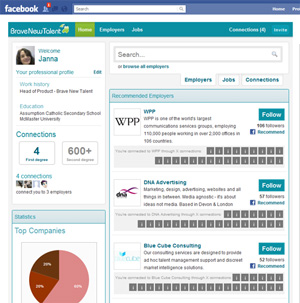
Case in point: This weekend, when we held our first official ”hackathon“. We needed a Facebook application, fast. With our client list growing, we needed to create a destination for Talent to find employers that they are suited for, find friends (and friends of friends) that work there, and get their hands on the right job postings.
It had to be engaging. It had to be slick. It had to sum up all of the hard work we’d put into a full API revamp and design overhaul we’d been working on for the last several months. It had to be something we’d all be proud of.
Thinking fast and talking smooth, I gathered a team, all of whom joined and contributed with gusto:
- Joanna Chlasta, our rock-star back-end developer
- Dimitris Havlidis, our front-end ninja
- Ed Kendall, our uber-dedicated bug-squashing intern
- Andrew Walker, Joanna’s other half, and a front-end developer at Nature.com
- Simon Cast, a fellow Head of Product at PeerIndex
- Harry Marr, a developer at Conversocial, borrowed for the day from the office on the ground floor
- Eamonn Gahan, a Facebook developer with iPlatform, also borrowed (thanks!)
While Ramon, our marketing guru, couldn’t make the weekend on short notice, he’d submitted some contributions by Sunday morning with his thoughts on how we can bring it to the masses. Lucian, of course, was there, tweeting our progress, bouncing ideas around and making sure everyone was fuelled and fed. The support and enthusiasm of all was infectious.
With this team, we set out what we meant to do. By the end of the second day, we’d created the app to about 80% completion – a working prototype, essentially, which we could begin showing off, getting feedback on, and coming up with a grand plan for the launch.
The big thing that we gained, however, was not the app itself. The personal growth in the team speaks for itself. We all learned a little bit more about each other, stretched our personal knowledge, and (dare I say?) bonded in those late nights and early mornings. We made something we were proud of, and we had fun doing it.
As a result, we’ve got an application ready to be launched on Facebook, which was built entirely in-house (with a little help from our friends!), and also picked up the knowledge needed to take it to the next level.
There was nothing quite as rewarding (although the lunch at Inamo came close) as being able to show off the completed app on Monday morning to the rest of our team, who with fresh eyes, immediately ooh-ed and ahh-ed (and picked and prodded) over what we’d created that weekend.
We continue work on the app this weekend, pulling in the last loose ends, and plan on launching next week.
I can’t wait for the next opportunity for a “hackathon”. It’s not something to be done every weekend, but it was worth every moment for this one.
Any other good stories of successful (or not so successful) hack-type weekends? As a product person, I’d love to hear about others pulling this off… and seeing the result!